
What is Polkadot Hub?
Polkadot Hub is a modular smart contract platform that supports both EVM and RISC-V-based contract execution.
Polkadot Hub makes it simple and fast to get started in Web3. Application developers now have a platform to deploy directly to Polkadot's robust, secure infrastructure and access its core functionality, without operating a parachain (Polkadot rollup).
What you need to know:
- Polkadot Hub is Polkadot's new home for decentralized applications.
- EVM and PVM smart contracts, staking, governance, identity services, and token and asset management are all supported on Polkadot Hub.
- Ethereum smart contract developers will experience a familiar onboarding journey and can use known tooling to get started with Polkadot Hub via EVM.
- PVM, a RISC-V-based VM, unlocks more advanced smart contract use cases.
- Polkadot Hub provides application developers with Ethereum compatibility, interoperability across the Polkadot ecosystem, bridges to other ecosystems, and the possibility to scale via parachains later.
- Polkadot Hub simplifies interacting with the underlying protocol infrastructure.
Polkadot Hub is not a single parachain, but Polkadot imagined as an L1 application platform, providing foundational technology that will shape the next decade of Web3.
What does Polkadot Hub provide developers?
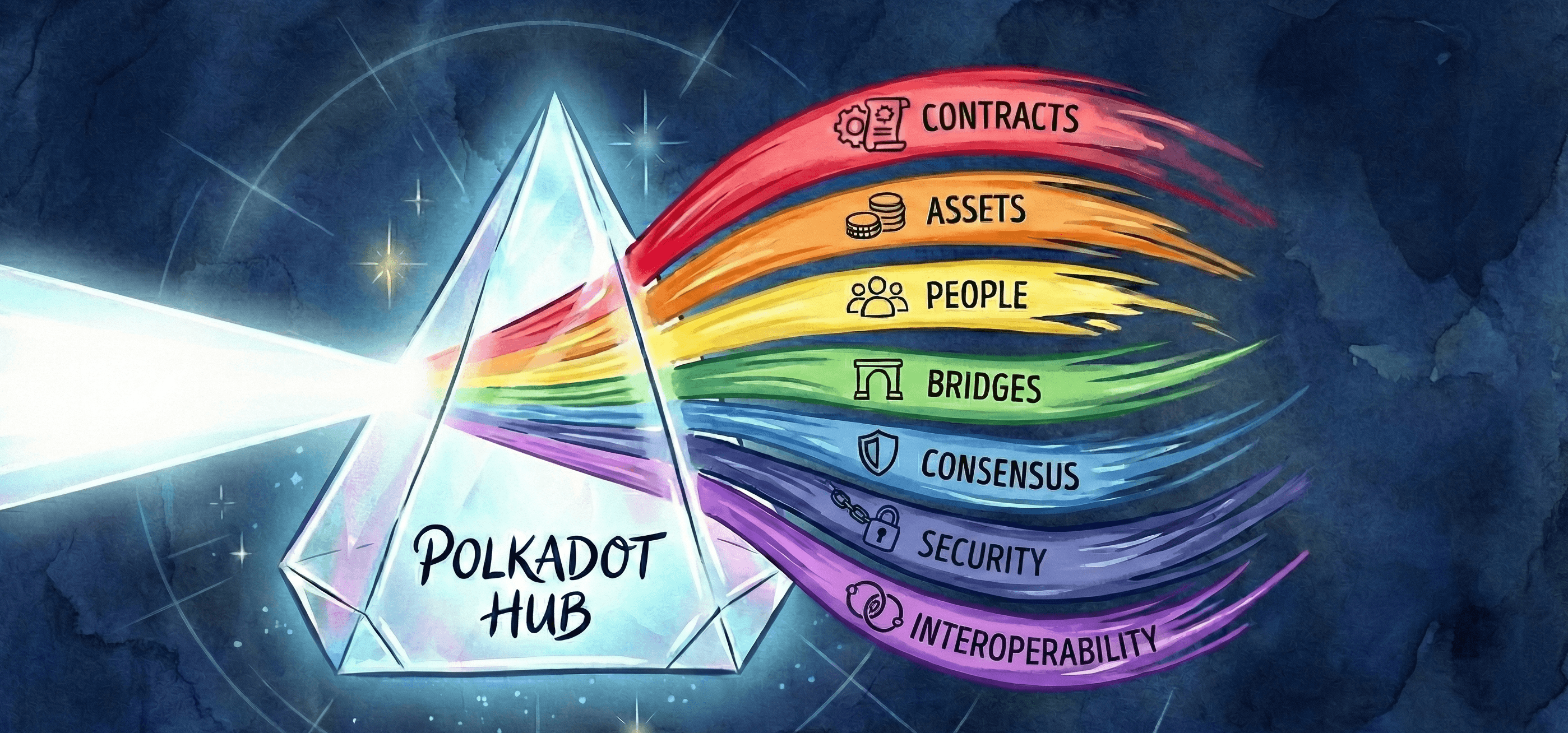
Polkadot Hub provides developers with a comprehensive platform for building and deploying decentralized applications, without requiring expert knowledge of Polkadot's underlying infrastructure.
Smart contract execution (Revive)
Smart contracts on Polkadot Hub are powered by Revive, a modular VM environment that delivers both EVM compatibility and next-generation RISC-V performance.
Revive's key features include:
- Unified execution (EVM + PVM): a single address space with a unified gas model, where EVM and PVM contracts coexist natively, interact, and sync directly.
- EVM: full Ethereum compatibility. Developers can deploy existing Solidity smart contracts directly using standard tools and libraries like Remix, Hardhat, Foundry, and OpenZeppelin.
- PVM: a high-performance, RISC-V-based engine optimized for larger smart contracts and compute-heavy workloads (crypto primitives, simulation loops, risk models, ZK logic). It already supports smart contracts written in Solidity and Rust.
- Precompiles: popular Ethereum precompiles, and Polkadot-native smart contract precompiles for actions such as cross-consensus messaging (XCM), external asset registration, and identity management.
- DOT utility: smart contract fee payment in DOT, giving DOT clear, programmable utility.
Developer experience and tooling
Polkadot Hub provides smart contract developers from other ecosystems a quick start on Polkadot, with familiar workflows and tooling, live support, and paths to scale.
- Workflow: Developers can deploy EVM contracts as-is using Remix, Hardhat, Foundry, and OpenZeppelin templates, and explore contracts on Blockscout.
- Support: Onboarding is simplified with detailed documentation, tutorials, and live chat support for developers on Telegram and Discord.
- Scaling: Polkadot Hub scales elastically to avoid congestion, and projects launched on Polkadot Hub can migrate to their own dedicated "rollup" if needed.
Core Polkadot features and performance
Polkadot Hub provides smart contract developers synchronous access to Polkadot's core logic and features, without building a parachain. These include:
- Asset management: native support for DOT, stablecoins, and external assets and liquidity.
- Interoperability: built-in XCM for messaging and assets between parachains within the broader Polkadot ecosystem; bridges to external networks (like Ethereum).
Polkadot Hub inherits the high performance and capacity of the wider Polkadot network:
- Reliability SLOs: Polkadot will be the first large blockchain network to monitor and publish (coming in the next quarter) key reliability metrics: high throughput (TPS); low latency (two-second block times); high availability (few declined transactions, even during congestion); low transaction costs; fast finality (seconds, not days).
- Security: secured by Polkadot's full validator set, Polkadot's sharded architecture ensures transactions are fully verified with no trust assumptions.
What problem does Polkadot Hub solve?
Polkadot is entering its "Second Age", shifting focus from protocol engineering to end-user applications and products. Polkadot Hub accelerates this shift, ensuring the experience of running applications and products on Polkadot matches the protocol's technical strengths.
Polkadot Hub:
- makes on-chain application development easy: industry-standard Ethereum workflows and tooling; assets and logic in one place
- makes off-chain application development easy by simplifying interactions with the underlying system chains (shared infrastructure parachains).
Historically, building on Polkadot required big architectural decisions with long-term implications from day one. The app development path was less clear, and developers had to choose between building a full parachain, deploying WASM contracts, or deploying on an EVM-compatible parachain. Each path was powerful, but isolated.
Before Polkadot Hub, developers (and users) experienced fragmented tooling, a high barrier to entry, and async flows for core functions:
- smart contracts lived on parachains running EVM or WASM environments
- core logic was spread across the Relay Chain and various system chains
- XCM was required throughout to coordinate between components.
How does Polkadot Hub work at the protocol level?
"Polkadot Hub" refers to:
- all the functionality on Polkadot's system chain infrastructure (including the Relay Chain's security; Asset Hub's asset management and smart contract execution; Bridges Hub's connections to other ecosystems), and
- the tooling and abstractions that sit across this infrastructure, creating a surface on which developers can build applications where end users don't need to know which system chain they are interacting with.
As well as assembling system chains into one coherent platform for smart contract developers, Polkadot Hub is the nucleus for the entire Polkadot network, including parachains. Polkadot Hub provides security and enables messages to flow within the ecosystem (via XCM) and beyond (via bridges).
System Chain architecture
Polkadot has a natively sharded infrastructure. Instead of a single main chain with added scaling solutions such as rollups, Polkadot's network consists of many interoperable parachains. Parachains are all equally and natively secured by the Relay Chain, with network-level functionality available on specialised system parachains ("system chains").
As of publication, these individual system chains collectively form the infrastructure of Polkadot Hub:
- Relay Chain: Coordinates the entire Polkadot system by providing shared security and facilitating block validation.
- Asset Hub: Manages all user-facing functionalities, including accounts, balances, transfers, staking, asset management (including NFTs), and hosts Revive, the smart contract execution environment.
- Bridge Hub: Enables trustless bridges between Polkadot and other blockchain networks, including Ethereum.
- People Chain: Manages user account identities.
- Collectives Chain: Hosts on-chain governance collectives, such as the Polkadot Technical Fellowship, that guide network stewardship and decentralized decision-making.
- Coretime Chain: Enables parachains to purchase computational resources (coretime) on Polkadot.
For more technical details on the overall architecture, see the Polkadot Hub documentation.
The Revive smart contracts layer: EVM and PVM
At the heart of Polkadot Hub is the Revive environment, a modular smart contract execution layer:
1. REVM: Rust implementation of EVM, Ethereum's stack-based virtual machine, providing full Solidity support, out-of-the-box compatibility with MetaMask, Remix, Hardhat, Foundry, and standard JSON-RPC calls.
2. PolkaVM: RISC-V--based PVM architecture designed for performance, future extensibility, and blockchain-specific workloads. PolkaVM, Parity's PVM implementation, is accessible for developers new to Polkadot with Solidity support (including Hardhat and Foundry (with Polkadot plugins)), Rust contracts possible, and multi-language support coming.
Revive also offers a unified gas model. Polkadot's underlying runtime uses a weight, size, and deposit model, but Revive abstracts and exposes it as a "standard" one-dimensional gas across both VMs.
For those of you after more technical details on Revive, see the developer docs, or sit tight for the next blog in this series: a deep-dive on our modular VM architecture.

How has Polkadot Hub evolved since mainnet launch?
Polkadot Hub is not a brand-new blockchain, parachain, or system chain.
- Polkadot Hub started at Polkadot genesis (in 2020) in a very basic form, providing only DOT balances, staking, and governance.
- It evolved incrementally to add identity, nomination pools, OpenGov, stablecoins, and more. However, the focus was primarily on security, with limited attention to developer experience.
2025 Asset Hub migration
As well as building Revive for smart contract execution last year, Parity developers also completed the Asset Hub migration, a major engineering achievement.
The Asset Hub migration:
- is a key architectural shift, moving balances, staking, and governance from the Relay Chain to be co-located with smart contracts execution.
- removes the need for cross-consensus messages (XCM) in core flows and means developers have everything they need in one place on Polkadot Hub.
- means the Relay Chain is now lighter and faster, future-proofing it for years to come.
You can read more about the migration in Gavin Wood's 2025 round-up.
How will Polkadot Hub further mature in 2026?
Now that a strong foundation has been laid, Polkadot Hub's 2026 roadmap focuses on enhancing performance and developer experience:
- developing PolkaVM's Just-In-Time (JIT) compiler for near-native execution speeds
- supporting more languages via PVM's RISC-V-based backend
- supporting gas payments across any asset, by automatically swapping for DOT under the hood.
- supporting synchronous staking and governance smart contract integration, as well as other deeper system-level capabilities, via advanced precompiles
- building out APIs and interfaces to further abstract chain complexity for frontend devs
- launching our Proof of Personhood protocol and integration into apps (e.g., free transactions for proven persons)
- revamping the staking system to harness Proof of Personhood
- adding more decentralized infrastructure, so product developers can make truly unstoppable applications.
How can developers begin on Polkadot Hub?
Polkadot Hub is designed to be the default entry point for application builders. Whether you are migrating your project from Ethereum or building something new in Rust, the path is now open.
- Start building: Follow the "zero to hero" dapp tutorial in the documentation to spin up a frontend and contract in minutes
- Get support: Join our developer channels for live support and updates
- Learn more: Visit the Polkadot Hub reference documentation for deep dives into the architecture.