
Playground . dot - What Happened When 190 People Built on Polkadot at Web3 Summit 2026
What Happened When 190 People Built on Polkadot at Web3 Summit 2026
Web3 Summit was never meant to be a hackathon. It was a festival. Two days of talks, panels, art, music, and late-night conversations at Funkhaus Berlin, built around the conviction that the questions shaping our digital future deserve a broader room than engineers alone can provide. Most people who came through the doors that June weekend came to listen, think, and connect with others. Nobody arrived planning to ship software.
And yet.
190 people deployed a decentralized application on Polkadot across two days. Most had never touched the stack before. Between them, they published 272 .dot domains, earned 22,820 XP across 187 builders, gave each other 469 stars, and forked 49 apps from one another's code. The entire experience ran on a temporary demo network that existed only for the event and was wound down after the event. It was built on open-source proof-of-concept infrastructure that Parity published ahead of the Summit.

That it worked at all was the point. That it worked this well was something else.
The hypothesis
The idea behind Playground was simple. Could someone with no prior Polkadot experience deploy a working decentralized application in around thirty minutes? Start by working on open-source code, modify it with AI-assisted tooling, publish it to a decentralized stack with no local environment setup, no faucets, or token acquisition.
Simple to describe. Difficult to execute. Every design decision flowed from that constraint. On Ethereum, you can get to a similar result with a wallet provider, an IPFS pinning service, an ENS resolver, and a faucet. Playground replaced that assembly with a single approval.
Building an app from scratch can be intimidating, even for experienced engineers in an unfamiliar environment. The team's answer was to remove every unnecessary step --- and then remove a few more.
No wallet. No mnemonics. No faucets.
Once a developer had the Polkadot mobile app, that was it. A single approval of "Become a Builder" provisioned everything they needed. Gas for transactions. Storage authorization on Bulletin Chain. An on-chain identity binding. A .dot domain. The Polkadot App held the root key on the developer's phone. Their private keys never left it. Playground only ever saw the signature.
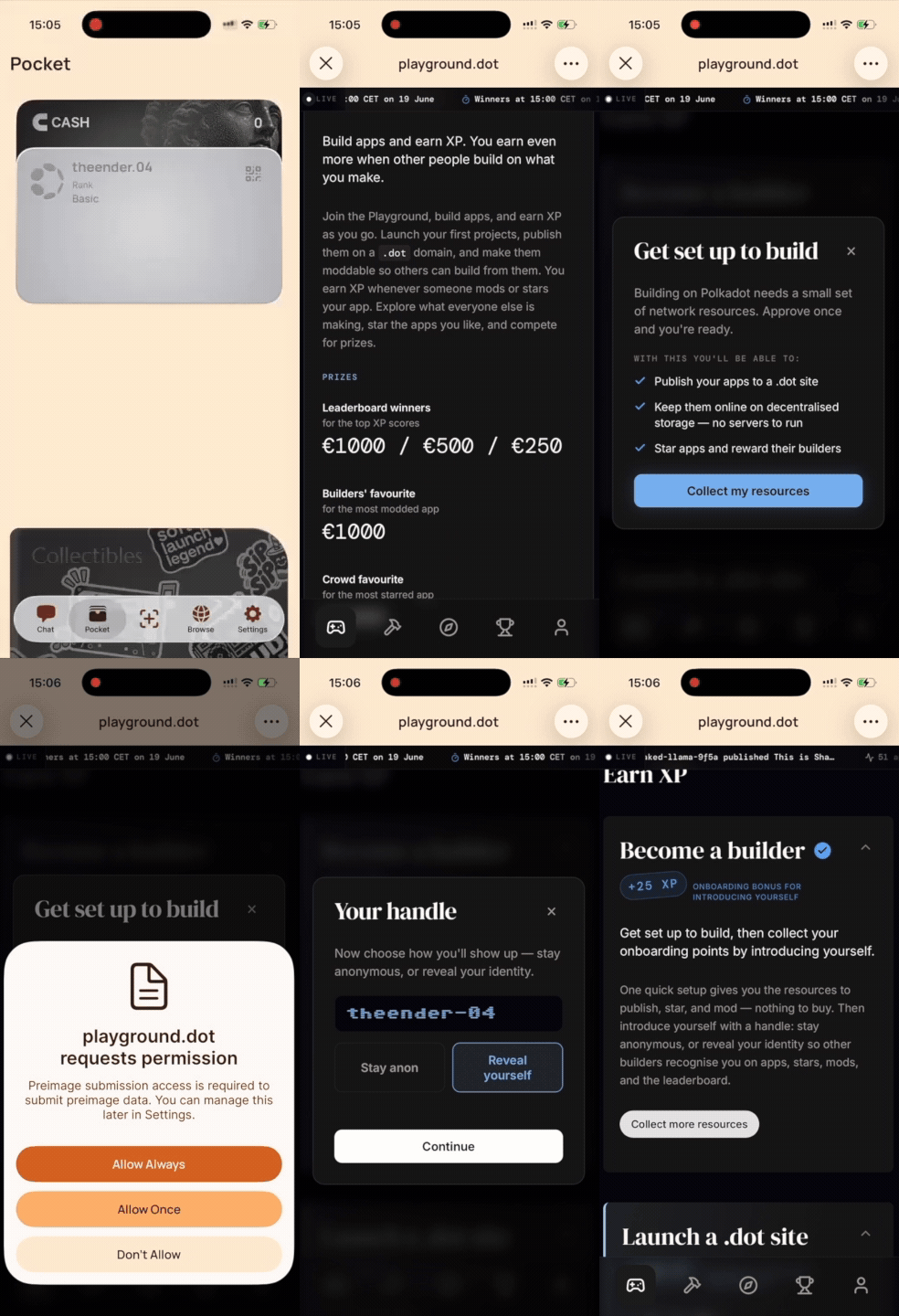
Developers were funded with PGAS - the gas token for smart contracts and everything else on Polkadot Hub - without topping up anything or thinking about fees. The Ethereum-compatible address mapping and the storage authorization for Bulletin Chain were folded into the first deploy rather than surfaced as separate steps. From the developer's point of view, none of that existed. They approved once and started building.
Two paths to a live app
Playground offered two ways to build, designed for different contexts and comfort levels.
The Playground CLI covered the entire lifecycle of a Web3 app on-chain for the first time in the Polkadot ecosystem: build, deploy, contract handling, and domain name registration via dotNS. All of it without copying and pasting keys. Login started with a QR code in the terminal. The developer scanned it with their phone and approved it. That was the authentication with no need for a username, password, or OAuth flow in a browser. After that, the phone stayed in the pocket for most of the work, and it did. It came back out only for the steps that warranted it: domain registration, contract deployment, anything that moved value.
RevX was available for developers who did not want to go near a terminal at a festival. A full browser-based IDE built by Leonardo Custodio and Talles Borges, RevX lets developers modify existing apps, lean on AI assistance, and preview changes live, all from a browser tab with nothing to install. Rust compilation ran on RevX's build servers in sandboxed containers. The browser tab ran a live, hot-reloading preview. The entire mod flow happened in the browser.

And for non-engineers, or anyone who found "build an app" too intimidating, there was the site builder. A no-code editor built into Playground.dot, it worked on any device, including a phone. Start from a template, compose with blocks, or write Markdown or HTML. One tap and the page was live on its own .dot domain, hosted on Bulletin Chain, with no server to run and nothing to maintain. A real deployment on real infrastructure, earning deploy XP like anything else.
The three paths shared the same underlying stack. They just met people where they were.
What people built
The Playground area filled up fast. By the end of day one, it was already clear that something was happening that went beyond the metrics. And people were engaged beyond simple building.
The long tail tells the real story. 159 static sites and 113 interactive apps. Games, social tools, utilities. Snake clones. A Morse cipher. A word counter. A chiptune toy. A donation page for cats and dogs. A cypherpunk manifesto. A cargo-ship DAO. Built in two days, on infrastructure most of the builders had encountered for the first time that morning.

The lineage map told its own story. 49 of the 272 apps were mods or forks of someone else's code. 14 apps were modded by other builders. The most-forked tutorial seeded nine mods on its own. People found each other's work, got inspired, built on it, and pointed others toward it. That collaborative layer was the entire point of the experience and happened without orchestration.
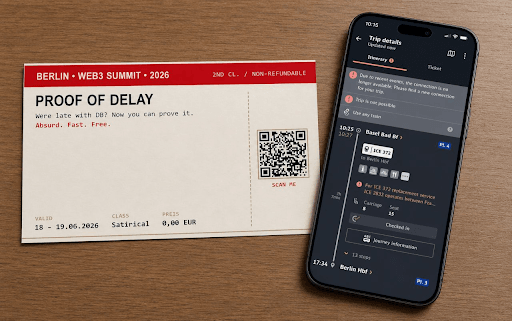
The Most Modded App winner was built by Andrey Dodonov (dodonew) - a Proof of Delay app inspired by a four-hour Deutsche Bahn delay on his way to Berlin. His app verified real-world delays on-chain, generated tamper-proof certificates, and turned waiting time into a game mechanic. A real user experience and a point of friction gave way to a decentralized, gamified proof of concept.
What held up
Across approximately 144,783 extrinsics over two days, the failure rate was 0.11 percent. 160 failures, concentrated in 21 accounts, with the majority being smart contract reverts rather than infrastructure problems. Bulletin stored 3,867 objects or around 1.07 gigabytes of app metadata, icons, and frontends, and served them back without issue. Nobody was asked to top up a token, buy gas, or fund a wallet. PGAS handled fees in the background.
This was a real milestone for infrastructure this young, running live under real event conditions. The most encouraging thing was how much of the stack disappeared. The layers that took the most effort to build mostly just ran.
The leaderboard held too
A leaderboard at a blockchain event is usually an invitation to game. The scoring system was designed around that problem from the start.
Every scored action was signed by an account bound to a real person through Proof of Personhood. Self-starring reverted. Double-starring reverted. A domain could mint its first-deploy XP exactly once, ever. The ceiling on self-generated XP was 325 points. Everything above that required other developers to engage with what you built to validate it.
The protections held throughout. Cross-referencing chain-wide account behavior confirmed it. The top community builder by XP was also a top name-collector. The highest-transaction accounts with no identity binding were services and automation, not builders. The leaderboard reflected genuine effort from real people - the exact foundation of a human Web3.
The winners
First place went to Armando Medina, building as armsves.01, with 2,345 XP.
Second place to Torsten Schenk, building as misca702, with 845 XP.
Third place to Hernando Castano Luna, building as Naadoo, with 795 XP.
The Most Modded App prize went to Andrey Dodonov (dodonew) - the Proof-of-Delay builder.
The Most Starred App prize went to Karam Alhamad (Zendetta).
Wildcard prizes went to Josselin Hanel and Bruno Galvao for their participation and creativity that stood out beyond the formal scoring criteria.
Two additional prizes were passed to the Polkadot Blockchain Academy - one for open knowledge contributions, and one for builder impact.

The team
None of this happened by accident. Playground was a large effort across Parity, built by people working on infrastructure that was itself still under active development.
Playground was a company-wide effort. Engineers, product, platform, legal, and operations - people across Parity contributed to what ran at the Summit, often building on infrastructure that was itself still under active development at the same time. The stack that made 190 deployments possible was not assembled by one team. It was assembled by many, working in parallel, shipping toward the same deadline.
What comes next
Playground was a proof of concept. And it proved the concept.
As we enter the next stage of development and growth for Polkadot. Playground will become the front door for developers arriving on Trinity. One cohesive onboarding environment where new builders get their first real experience of the stack without fighting the infrastructure to get there. The tutorial system will grow. The deploy pipeline, the scoring logic, and the Sybil-resistant identity layer all have a second life as the blueprint for future hackathons and developer events.
The reputation Polkadot carried going into Web3 Summit was that it was powerful but hard to build on. For two days, for 190 people who had never tried, it was not hard. For the team that built Playground, that is the result worth building on.